

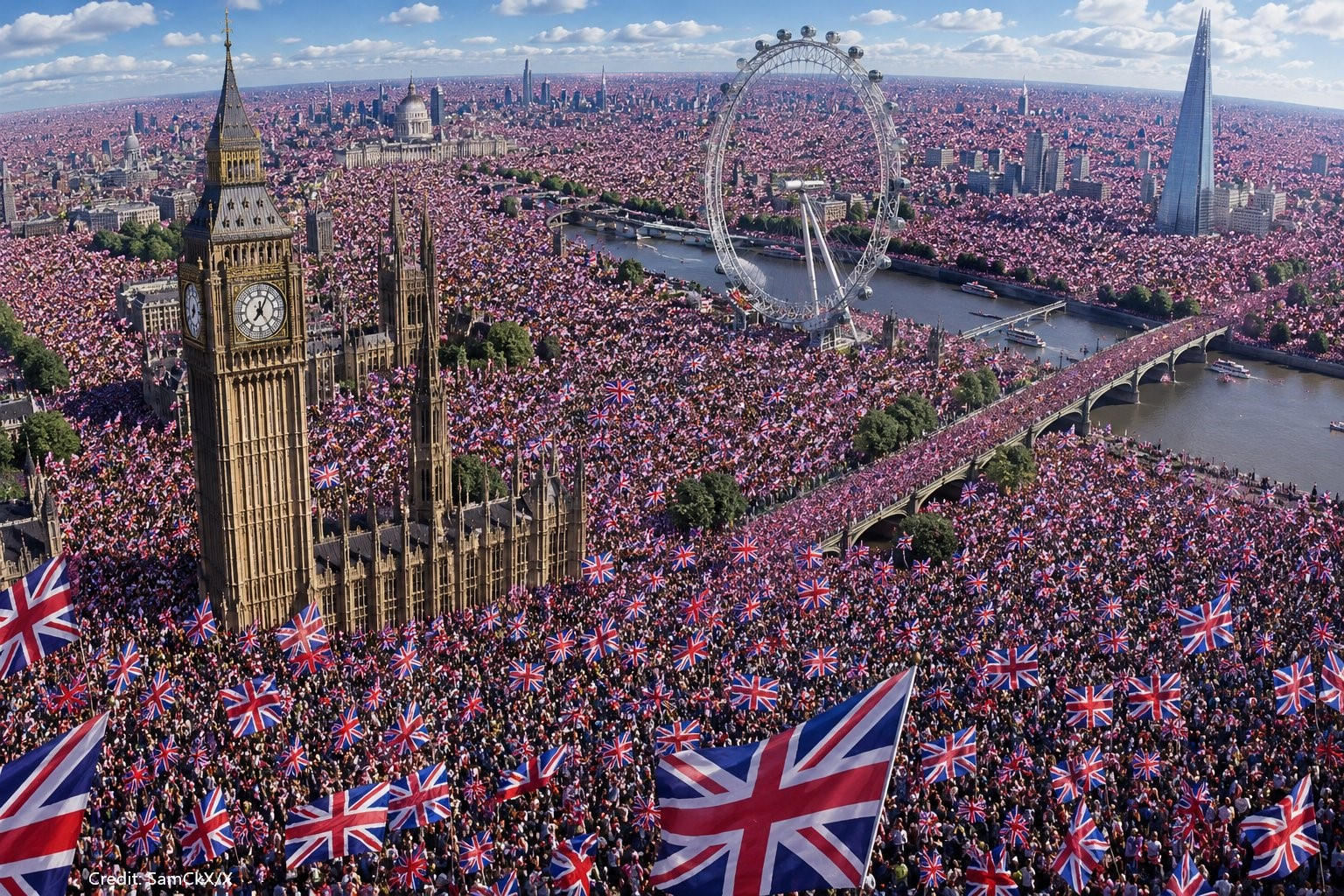
A leading misinformation expert has warned that the posts fabricate a British “revolution against multiculturalism.”
Misleading AI-generated material showing millions of Britons staging a revolution against immigration have appeared online following last Saturday’s Unite the Kingdom rally in central London.
Fake images and videos depicting masses of white Britons marching on the streets were circulated on social media platforms X, TikTok and Instagram before, during and after the event.
The rally was organised by far-right former football hooligan Stephen Yaxley-Lennon – better known by his alias Tommy Robinson. Despite Robinson’s claim that “millions of patriots hit the capital of England today in the largest patriotic display the world has ever seen,” early police estimates put attendance at just 60,000 — less than half the previous Unite the Kingdom march in September.
Despite this, the event attracted outsized attention online, with much of the content AI generated, and painting the movement as a grassroots uprising.
Rachel Blundy, a fact-checker and Deputy Head of Digital Investigations for Europe at Agence France-Presse said she has seen the spread of AI-generated clips on major platforms in the last year that implied there was a popular British revolt against mass migration.
Read more: Amazon to use AI-personalised ads on Prime Video
Read more: Activists protest social media harms at Meta HQ as Labour mulls ban for teens


“Generally, they’re suggesting that we’re having some kind of revolution against multiculturalism, and sometimes the posts are suggesting that a march is happening right now.”
Although much of the content depicting exaggerated crowd sizes could easily be identified as fake, Blundy suggested this has little bearing on how people respond to it.
“Social media users now are getting more savvy about what’s real or what’s fake, but they’re not actually always so concerned about the fact that it was fabricated as long as it aligns with their particular values,” she said.
A recent study in a December 2025 edition of Science suggests that AI is capable of persuading people’s political allegiances. According to OFCOM’s 2025 news consumption report, over half of all UK adults (51 per cent) use social media specifically for their news.
As AI tools become cheaper and more accessible, experts are growing increasingly concerned about the challenges of differentiating genuine and synthetic content.
Featured image credit: @archer_rs.
