

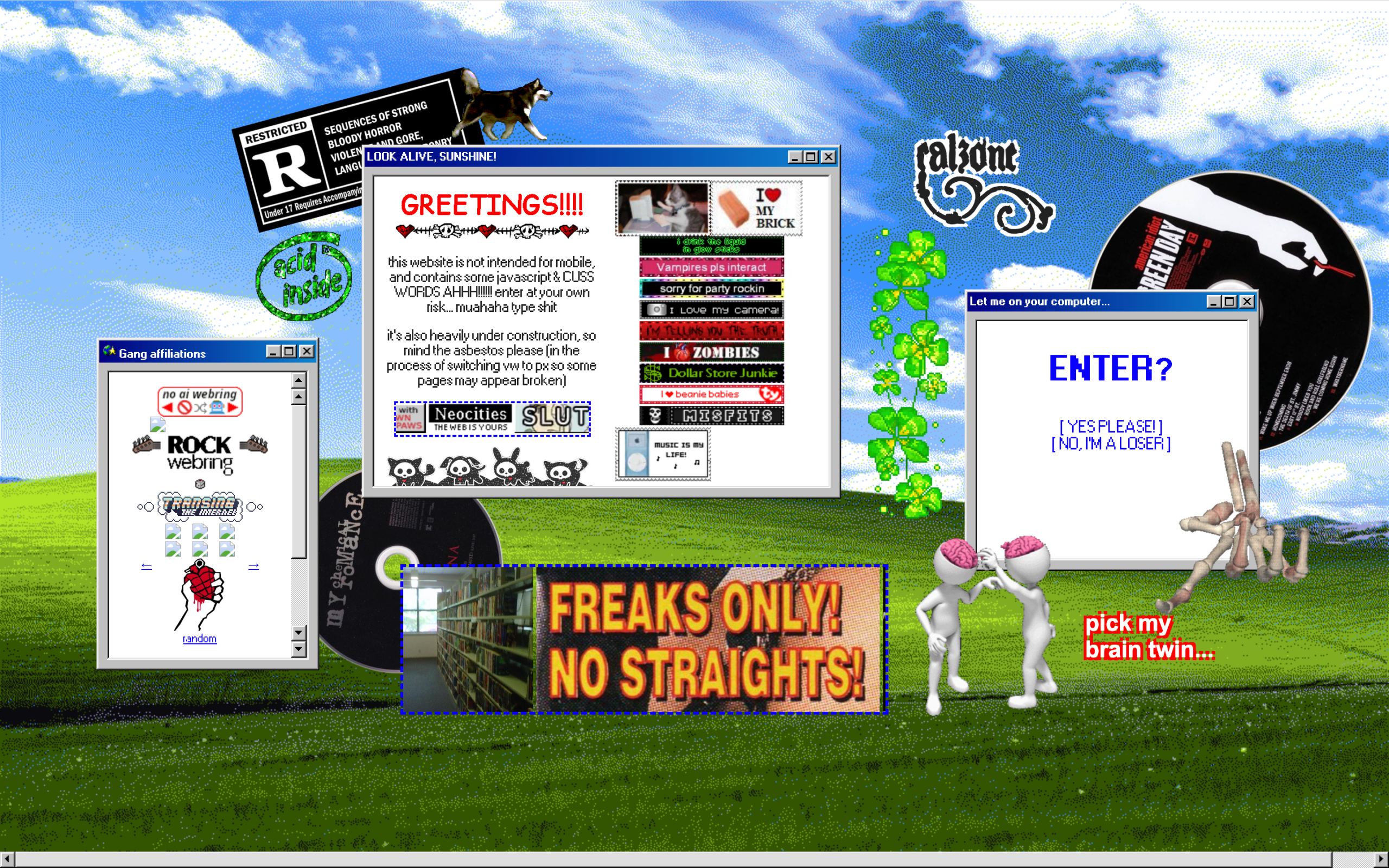
Entering Neocities.org feels like slipping through a digital wormhole. You surf through Tumblr-esque art portfolios, glossy, retro Windows-themed blogs and even hand-drawn explorative videogames. Before long, you might be convinced you might actually be in 2006, not 2026.
Neocities was founded in 2013 as a response to the closure of its predecessor, GeoCities. It invites people to create their own websites free of creative inhibition. As of 28 May, 1.6 million websites reside on the platform. Despite their retro appearance, the vast majority were created in recent years, with the number of sites tripling since the launch of ChatGPT in 2022 – a trend spearheaded by younger users as opposed to GeoCities veterans.
23-year-old artist Giovanna Fonseca launched her site, Knoxstation.neocities.org, in 2022 to showcase her work. It has since garnered over 400,000 visits.
“I was introduced to Neocities in 2022 and was in love with how every site I visited had its own unique look and feel. Everything felt so maximalist and that spoke to me,” she says.
Fonseca’s low-polygon graphics and glossy pop-ups may not be to everyone’s taste, but it is intimately human. This is most evident on her site’s many interactive pages, in which you are invited to play Rock, Paper, Scissors against a small creature called a “Chao”, or leave messages in an ever-expanding guestbook. For Fonseca, it is these features that matter most.
“The culture on Neocities is based on old web traditions and back then the internet really felt more like something you can use to connect with people – the interactions I’ve had through my guestbook and profile feel more genuine than any social media engagement.”
As Fonseca makes clear, this trend is not simply a surge of nostalgia for Y2K aesthetics. At the core of Neocities’ popularity is a longing for humanity – its “about” page claims its goal is to “rebuild the web we lost to algorithms and monotony”. With analysis by cyber security firm Imperva showing that bots now make up more than half of all internet traffic, humanity is something that today’s internet severely lacks.

When Fonseca started on Neocities, she says she “was more interested in just having a site to host my art and interactive work, but the more I kept interacting with the community, I realized how ‘political’ being part of the Indie Web is”.
The “Indie Web” is a community of independent sites that place emphasis on digital autonomy, and in recent years Neocities has been firmly at its helm. Individuals within this subculture, Fonseca included, shun the mainstream internet’s usual practices of chasing virality and monetisation in favour of personal projects.
“You’re choosing not to be part of the corporate web space where your platform doesn’t truly belong to you,” she notes.
Earlier this year, Neocities and the wider Indie Web was reminded that their corner of the internet is not impervious to the “corporate web”. In January, NeoCities founder Kyle Drake announced that for months the search engine Bing had been inexplicably blocking the platform – including all user subdomains. It was not until 11 February that Drake was finally able to get through what was described as “chatbot hell” and find a Bing support member to fix the issue.
Anne Lee Steele, a digital anthropologist specialising in online culture, believes that although the Indie Web is “fighting important battles”, it is far from winning the war against the digital mainstream.
“I think we’re in a huge era of play across the constellations of the ‘Indie Web’ universe, but I won’t pretend that this is the same thing as a revolution. It might, however, give us the sense of joy that makes revolution more possible,” she says.
Steele maintains that it is this sense of possibility that really matters, because it does not “adhere to ‘what already exists’, but rather asks ‘what is possible?’” That is apparent when browsing sites like Knoxstation.neocities.org, and something that, for Fonseca, is so important to foster and spread.
Featured Image Credit: An entire page on the ribo.zone website dedicated to ‘bugholding’. //Loren@ribo.zone)
