

Humanitarian aid is targeting local communities earlier than ever, but the sector is still learning to navigate the risks of emerging AI technology
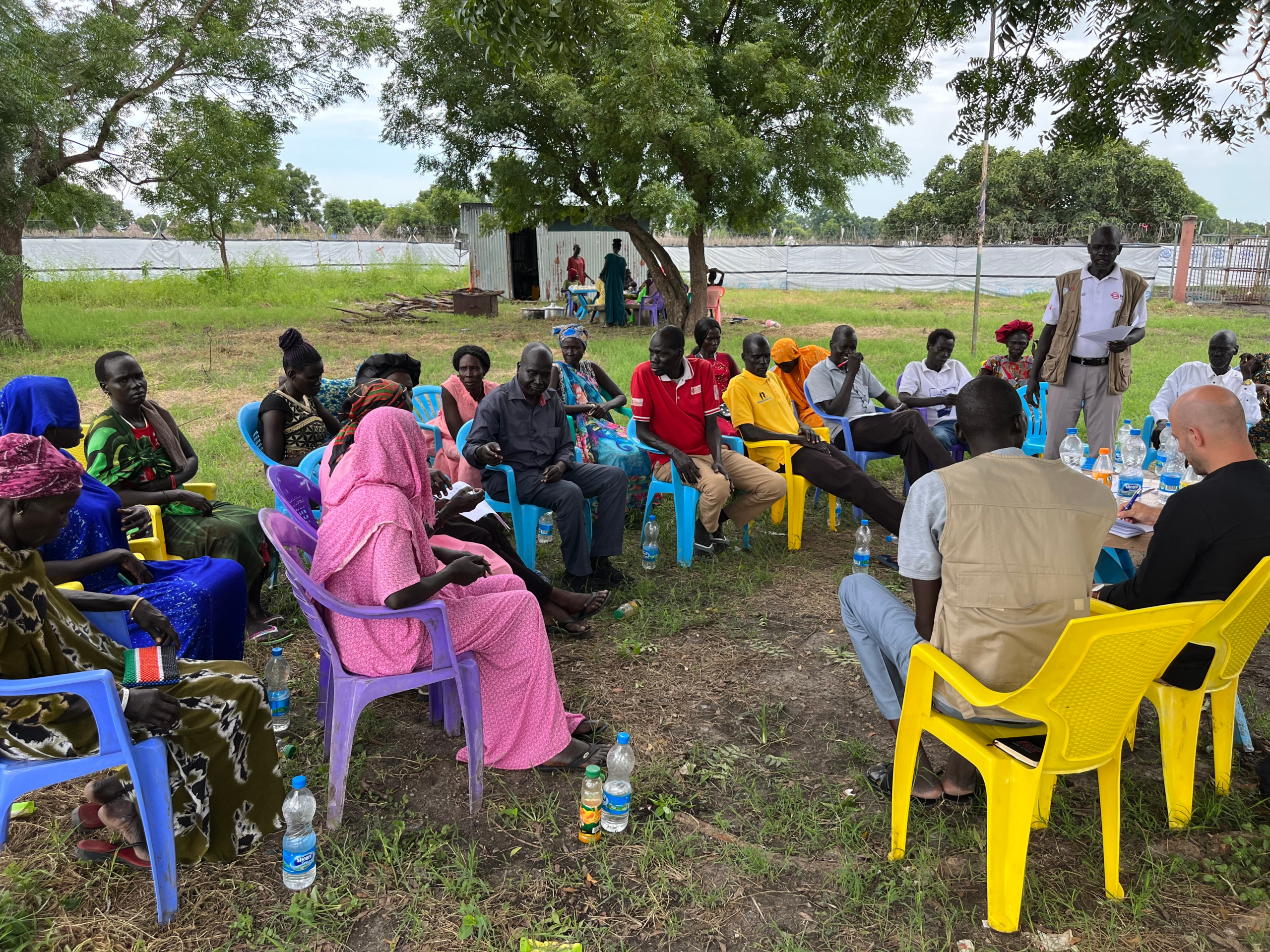
In a rural community in Akobo County, a region in eastern South Sudan, villagers gather in a modest circle to discuss how developments in AI can support them in the event of a displacement crisis. Even without mobile phones or laptops, the practice of forecasting future events for survival has long existed within their community. For them, the idea of predictive data modelling is not too far removed.
“The concept of using AI to predict future displacement,” says Alexander Kjaerum, a Danish Refugee Council senior data analyst who led the dialogue in Akobo, “was often easier and met with less scepticism than explaining it to colleagues in our HQ in Copenhagen.”
This weekly conversation was led by the Danish nonprofit throughout 2023. The data collected from the dialogue would be used to pilot a model for distributing early aid, including hygiene and period kits for women, food assistance and social cohesion activities, one year later.
The Council is one of the pioneers behind a traditional AI system of humanitarian data modelling. The piloted model in 2023 was fed a combination of open-source intelligence (OSINT), including historical data sources on conflict, food security and displacement, with transparent dialogue with communities in South Sudan.
Ray Eitel-Porter, a long-time government consultant on AI, explains that this is a “safer and more predictable” approach due to the absence of hallucinations and lower rates of security data breaches with generative AI models like ChatGPT and Claude. By mid-2025, over 13.1 million people had been helped by 154 anticipatory measures worldwide, a number predicted to rise this year as accuracy improves.
Indeed, the Council’s model forecasted an increase of 1,500 displaced people in Akobo, and by mid-May 2024, the resulting earlier aid activation prevented the displacement of 2,800. For every euro spent on the modelling, 23 euros were saved from prevented displacement and related expenditure. The return on investment, by this measure, was one to 23.
According to the Global Humanitarian Overview of 2026, the global funding gap is $33bn (£24bn), an all-time high forcing investments to stretch far.
“AI is just a means to an end […] which is to respond and protect forcibly displaced and stateless”
The AI forecast works within a three-month timeframe, and its accuracy is measured one year after predictions. So far, the model has an 85 per cent accuracy rate and has already been used across 11 countries globally. Work carried out by the Council is used to support larger humanitarian organisations. One of those is the UN Refugee Agency (UNHCR), which has clear outlines on the ethical use of AI and development partnerships.
Rebeca Moreno Jiménez, lead data specialist from the UNHCR, says that “the Danish Refugee Council inspired us. We peer reviewed their model”. She explains that from an organisational standpoint, “AI is just a means to an end […] which is to respond and protect forcibly displaced and stateless”. Crucially, there is no “one recipe fits all” approach with AI computational methods. From the work she oversees, Jiménez emphasises the importance of speaking with people on the ground, which increases the accuracy in her own data models and addresses ethical concerns that sidelining these local groups.
These piloted AI models have not been met without scepticism in the sector. Giulio Coppi, senior humanitarian officer at Access Now, a digital civil rights non-profit, warns that it could end up endangering communities. “If you start drafting very accurate models of displacement,” he argues, “you are basically telling the authorities or potentially hostile actors how to harm these people.” Publicly available forecasts, for instance, are not encrypted and carry further surveillance risks.
Eitel-Porter also explains that data can “reinforce previous patterns of behaviour” and bias given the history of colonial oppression in Africa. The Council recognises the care needed when navigating OSINT, avoiding, for example, the “use of social media data, as we believe this can be heavily biased”, Kjaerum says. It also states that the models provide “no new information” that could be used to harm communities.
False alarms, or false positives, are a further area of debate. These occur when predictions are inaccurate, and resources are inefficiently deployed when they could have been targeted elsewhere, causing local anxiety in the process. Working closely with local members to represent their needs is at the forefront of the Council’s work, Kjaerum explains, to avoid skewed allocation of aid. Their adopted “no-regret” policy means that aid distribution is considered worthwhile for targeted communities, irrespective of whether a crisis unfolds.
What is the future of data models in the sector? Amid funding shortages and public AI mistrust, it might not be a direct priority on the humanitarian agenda. The UNHCR backed their “positively cautious” approach as, unlike corporate entities adopting AI, the technology directly impacts vulnerable communities. With rapidly evolving AI data models being reserved for pilot phases, Coppi stresses that transformative technology “requires transformation” within aid organisations themselves.
For now, the role of AI in anticipatory aid has the potential to radically elevate the work of humanitarians at present if exercised correctly. “There is nervousness,” says Eitel-Porter, but “it is increasingly the case that AI will be used for forecasting and potential disaster situations.”
Featured Image: A Danish Refugee Council Worker in dialogue with local communities from Akobo County, Eastern South Sudan. Credit: Alexander Kjaerum
