

The Techtonic went undercover to see what connects a network of shady billionaires, a paranoid seller and Russia’s failed Moon landing
In 1974, after continuous failed attempts to land on the Moon thanks to catastrophic launch failures and poor funding, the Soviet Union realised that the United States had won the space race.
The Politburo of the Central Committee of the Communist Party quietly shut down the N1-L3 programme – the research group tasked with building rockets and training cosmonauts for a Moon landing. With no public announcement, staff were transferred overnight and reminded of their legal obligation to never speak of their work again. All hardware was ordered destroyed, and most records were burnt.
But, for $350,000 (£260,000) and free postage, an N1-L3 prototype space suit could be yours from eBay. Its journey from a Moscow warehouse to the e-commerce site is a window into the high-stakes underworld of artefact dealing, and shows how a piece of top-secret technology can end up pawned online.
Dr Daniel Salisbury is a fellow at King’s College London’s Department of War Studies, and has spent over a decade researching the illicit trade of arms and technology that followed the collapse of the Soviet Union.
“It doesn’t surprise me that the suit made its way to the West,” he says. “Given the poor Soviet economic situation and controls on state property, there are a lot of stories about all kinds of things being sold in the early 1990s as the USSR collapsed.”
“This included battle tanks, weaponry and even a lot of concerns about nuclear material being sold,” he adds.
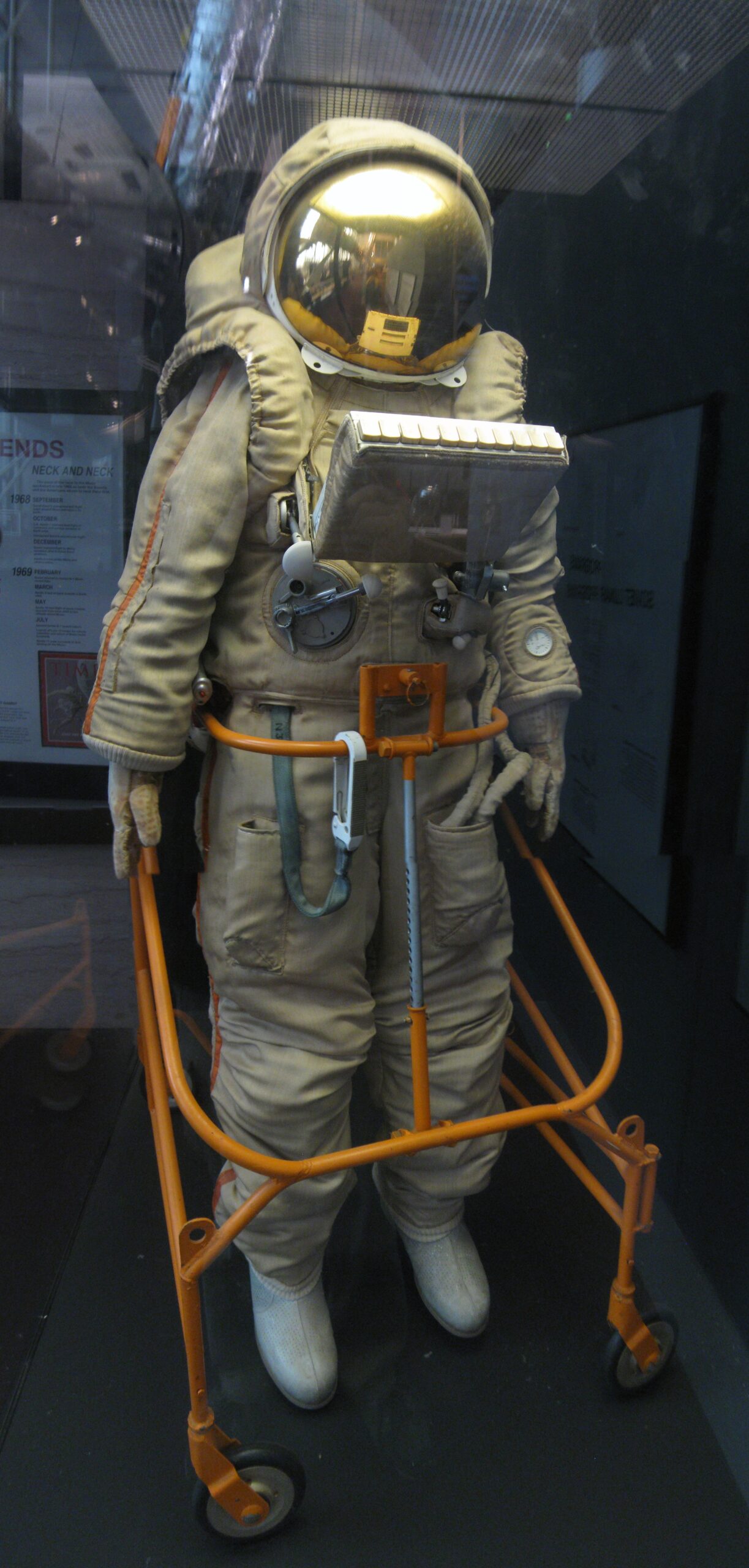
eBay user “Maksuta” claims to be selling the Krechet space suit – Russian for gerfalcon, an Arctic bird of prey. The prototype was manufactured near the end of the Moon-landing programme in 1967, and designed for use on the lunar surface.
Maksuta is a prolific seller of space antiquities, and appears to be selling matching gloves for the space suit. This Krechet is likely one of fewer than 10 still in existence.
In response to an interview request, Maksuta said: “Sorry, I’m not willing to talk about it. All what [sic] I know is written in the description. The market is space collectors and museums.”

The item description says the suit “was luckily saved at the factory” after the closure of the Soviet lunar programme. Beyond a 1999 eBay registration and anonymous reviews praising “awesome item and service!”, Maksuta’s profile gives nothing away.
The reason for Maksuta’s guarded approach became clear when The Techtonic approached them posing as two different wealthy American space enthusiasts. Maksuta divulged that the suit was not in the US as advertised, but was in storage somewhere in Europe.
After several messages, Maksuta explained that the suit was disassembled. Before they would order its reassembly for verification, they insisted on seeing a letter from a reputable US or UK auction house “to prove our intent and that we were ‘not from [the] secret services of certain countries’.”
According to Maksuta, the suit “was stored at Zvezda [factory] where it was manufactured and then rescued by some of its engineers from complete disassembly and destruction”. They warned that exposing who had then sold the suit to a “private collector” could put them at risk of being thrown in jail.
Founded in 1952 to develop aviation pressure suits and in-flight refuelling systems for the Soviet armed forces, Zvezda has developed every Russian space suit since.
According to several antique experts familiar with the topic, cosmonaut hardware was mostly sold in the 1990s following the fall of the USSR, when details of the N1-L3 programme began to emerge, by either cash-strapped museums, ex-staff or those with access to government warehouses.
One militaria salesman, who has sold deactivated military equipment – including old Soviet memorabilia – across Europe for 30 years, says that the market for space technology was dominated by European and American billionaires building private collections.
He adds that the rare and expensive pieces of technology are becoming harder to sell in Europe, due to a crackdown by Russia on the export of artefacts deemed culturally significant.
David Shayler has spent 40 years researching Russian spaceflight as a fellow of the British Interplanetary Society, the world’s oldest space-advocacy group.
Shayler explains that the Krechet is of huge historical significance. Conceptualised in 1960 as a “long-John” style suit, it was one of the first suits to have a “life support system built in, independent of the spacecraft in case of decompression”.
Soviet engineers who were in the final stages of building a lunar module to land cosmonauts on the Moon needed a new suit for the Moon walk, and put the Krechet into production in 1967. Fully pressurised and independent of the craft, the prototype let crew “float in through the back” for easy access.
The suit would also serve a second purpose: “to save you – to get you back home”. If the craft used to re-enter the Earth was damaged and air began leaking out, the crew could climb into their Krechets.
These features were considered so innovative that parts of the Krechet were incorporated into the Orlan space suit, used into the 2000s for Russian trips to the International Space Station.
The suit is one of many historically significant items from Russian history that has made its way to European black markets.
Maharram Akbarov, a Russian analyst based in Poland, says that ”in post-Soviet countries like Azerbaijan, carpets featuring Yuri Gagarin and many other cultural objects are […] being offered for sale online”.
“Many items produced in the Soviet era in Russia are sold through unofficial markets,” he adds.
Since 2018, smuggling cultural valuables out of Russia has been a criminal offence. The Krechet, being an artefact of historical importance and rescued against orders from the Zvezda factory, would likely attract scrutiny from any customs official.
As of this article’s publication, the Krechet remains listed on eBay, saved to 42 baskets. Its parts sit in storage somewhere in Europe, waiting for a wealthy patron to spirit them away into their private collection.
Featured image credit: Tyrol5
