

A decade ago, they were told to go home. Now they’ve made Poland a European tech hub – and Britain is wondering what it threw away
On the morning of 24 June 2016, just hours after the result of the UK’s referendum on European Union membership was declared, Polish families in Huntingdon, Cambridgeshire, woke up to find laminated cards posted through their letterboxes.
“Leave the EU / No more Polish Vermin,” the cards read, written in English on one side and Polish on the other. Cambridgeshire Police would go on to declare the incident a hate crime and open an investigation, but the culprit was never found.
A lot has changed in the decade since those cards were posted. According to the Office for National Statistics, approximately one million Polish nationals lived in the UK at the time of the Brexit vote. Today, that figure sits just below 700,000. In 2025, 25,000 Poles left the country, with just 7,000 coming the other way.
Poland is in the midst of what academics have hailed as an “economic miracle”. Over the past two decades its economy has doubled in size, growing at between three to four per cent annually – and is predicted to overtake countries including Australia and Canada in the coming years. The contrast with Britain, whose economy has remained effectively stagnant since Brexit, could hardly be starker.
Perhaps the most surprising aspect of this economic success story is how the technology sector has blossomed. In recent years, Poland has quietly become home to some of the most fertile ground in all of Europe for tech startups. The country is now home to more than 2,000 active startups, several of which are unicorns, meaning they are valued at over $1bn.
Poland’s tech ecosystem has also produced influential figures in Silicon Valley. ElevenLabs, founded by Polish engineers Piotr Dąbkowski and Mati Staniszewski, is valued at around $11bn. OpenAI co-founder Wojciech Zaremba studied at the University of Warsaw, while ChatGPT’s chief scientist Jakub Pachocki is from Gdansk. For Aleksandra Przegalińska, a Polish AI researcher and philosopher, this talent pool is no coincidence.
“Pachocki is a textbook case,” she says. “He was a six-time finalist of the Polish Olympiad in Informatics. The University of Warsaw’s mathematics and computer science faculty trains world-class engineers on a fraction of an MIT or Stanford budget. That olympiad-to-rigour pipeline is the real engine.”
Staying home post-university is increasingly attractive to local talent. “Ten years ago, the assumption among ambitious graduates was essentially one-directional: you trained, you left and that was the career,” Przegalińska explains. “What’s emerged since is what’s now openly described as a ‘reverse brain drain’.”
“What’s emerged since is what’s now openly described as a ‘reverse brain drain’”
Jakub Wyszomierski is one such example of this phenomenon. A machine learning analyst from Warsaw specialising in LLMs, he previously lived and studied in London before moving home in 2024 to work for the startup Tidio – an AI chatbot used by businesses to resolve common customer queries and complaints.
“In all honesty, I had a strong desire to move back to Poland from my very first days in the UK,” he says. “The cost of living in London always felt like a lifelong challenge if I stayed. At the same time, watching how my hometown transformed every time I visited only fuelled my ambition to move back.”
Although Wyszomierski concedes that Warsaw still has a long way to go before it can overtake the commercial and business output of London, he says this is a fact that excites rather than discourages him.
“The way I see it, London is a well-established, powerful warehouse with a wide range of equally well-established departments,” he says. “Whereas Warsaw can still be seen as an up-and-coming construction site where there’s a lot of room to lead the way and build things from scratch.”
This month marks the tenth anniversary of Britain’s decision to leave the EU and the legacy of that vote is unavoidable when discussing Poland’s rise. Recent analysis from the Office for Budget Responsibility estimates that Brexit will reduce the overall trade intensity of Britain’s economy by 15 per cent in the long term. A separate study published in December 2025 found that the UK economy is up to 8 per cent smaller than it would have been had the country remained in the EU.
“It’s hard to say whether I’d have been more willing to stay and work in London if not for Brexit,” Wyszomierski says. “What I can say is that the British–EU partnership made it possible for me to afford an undergraduate degree as a home student and allowed me to apply for a PhD with a stipend as an EU citizen – opportunities that weren’t available to my overseas friends and are no longer available to younger Poles.”
Poland’s trajectory is not without obstacles. An ageing population and historically strong public resistance to non-European migration – two pressures that helped to shape the Brexit debate in 2016 – may yet cap how far the country can rise. Polish president Donald Tusk has surprised many with his recent pivot to more anti-immigration populist rhetoric, seemingly reflective of broader public sentiment.
For many Poles still living in the UK, such as Michal Siewniak, this year’s local election gains for right-wing populist party Reform UK were a disturbing warning sign that they may not be as welcome as they once thought. Originally from Lublin, Siewniak has lived in the Hertfordshire town of Welwyn Hatfield since 2005 and currently serves as its mayor.
“We talk about it a lot,” he says when asked whether his family have considered returning to Poland. “People like Rupert Lowe [the Restore Britain leader] are talking about taking away my voting rights. I’ve lived here for 21 years; I’ve always paid my taxes. If people on the right were able to form a government, that would be the nail in the coffin.”
In many ways, the movement of people has been the defining story of Europe’s political landscape over the past decade. How Poland reckons with its own dramatic rise may yet demonstrate whether it has absorbed the lessons that Britain is still reeling from.
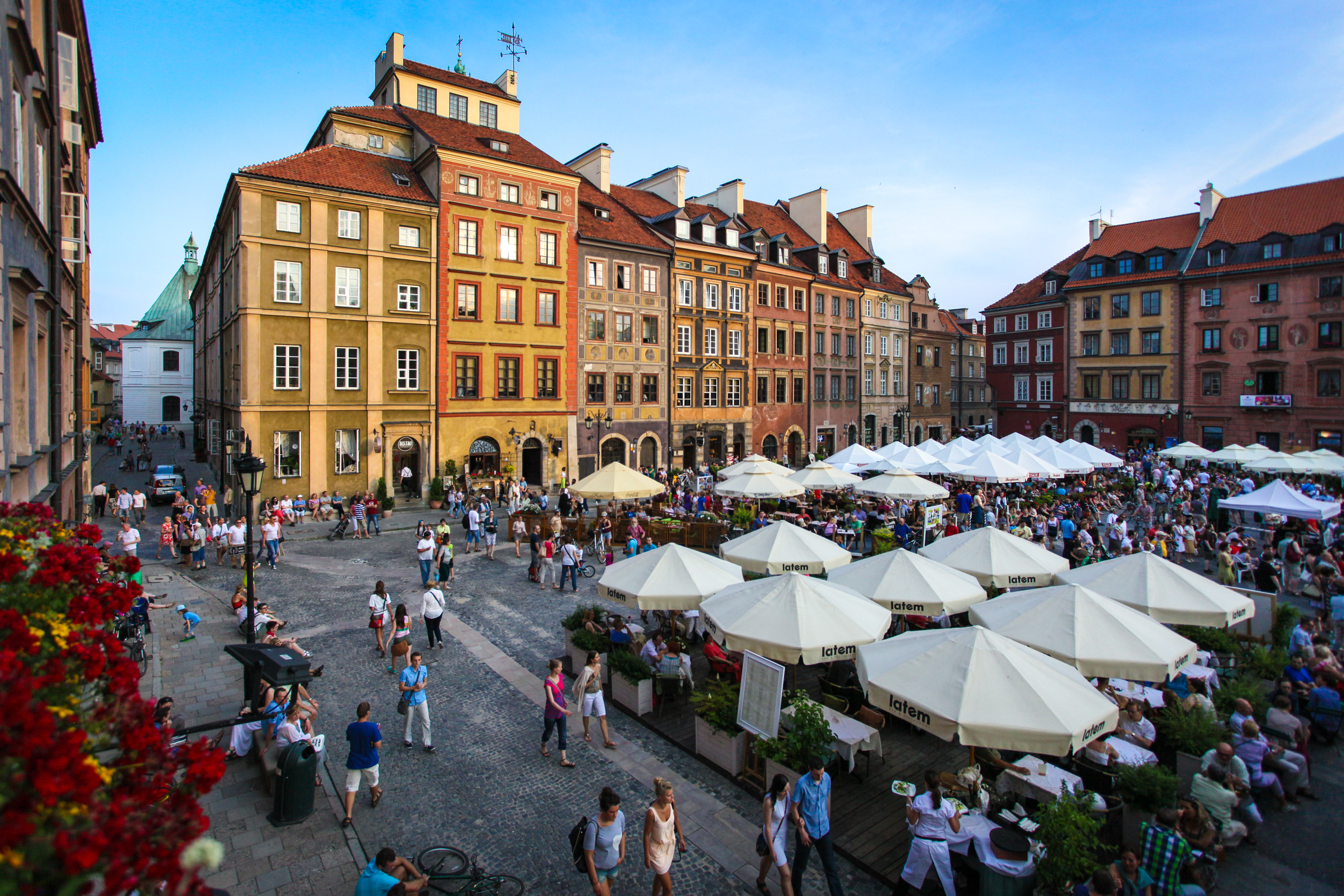
Featured image: Warsaw Old Town. Credit: Mariusz Cieszewski
