

Grassroots movements are asking whether the UK is sleepwalking into an AI crisis – and whether anyone in power is prepared to stop it
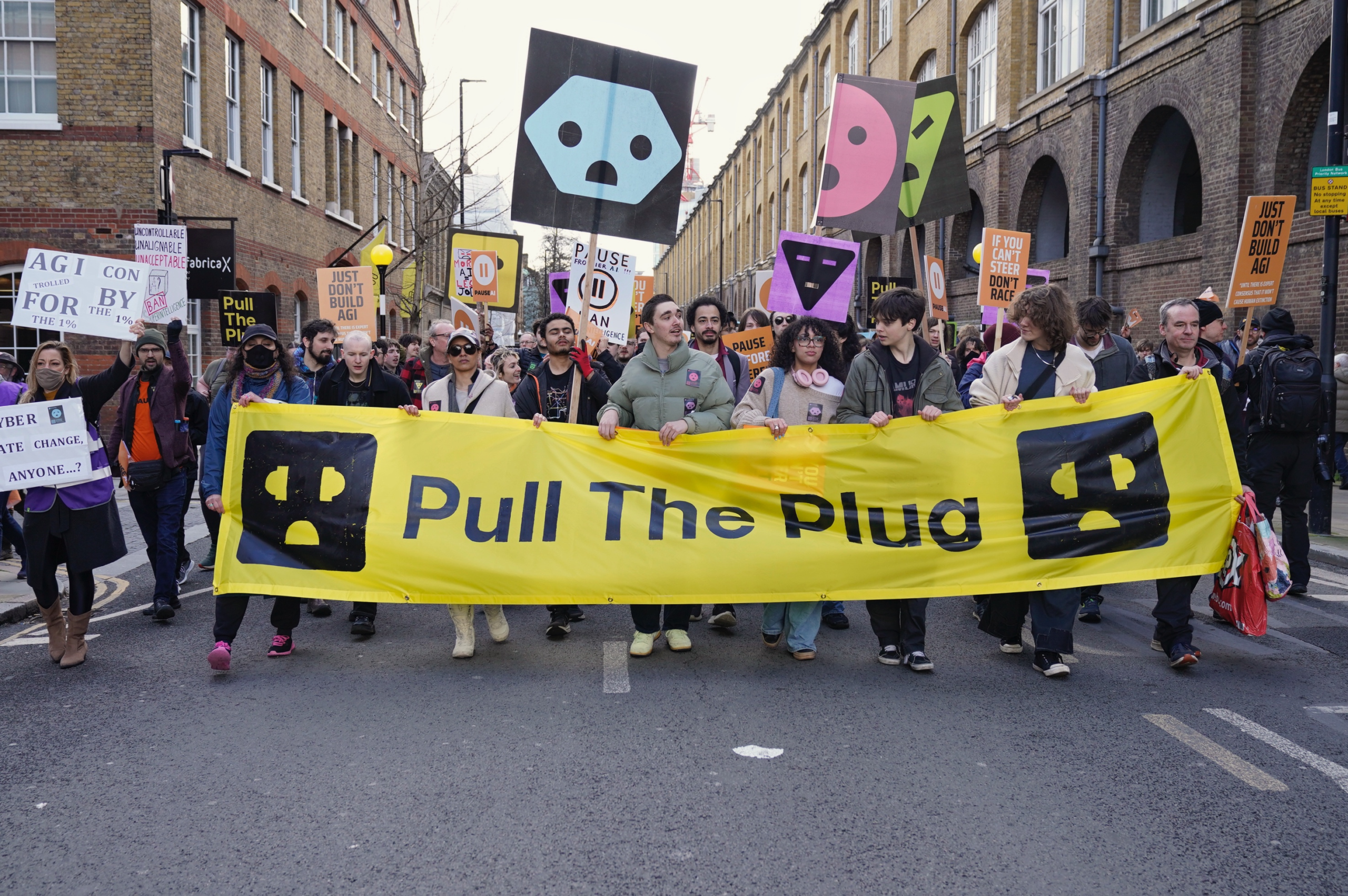
On a damp afternoon in King’s Cross in 2023, five people gathered outside the London headquarters of Google DeepMind – barely enough people to fill a black cab home. They had placards and a shared sense of urgency, but little else. One of them was a young man called Joseph Miller.
Three years later on a cool February day, Miller stood outside the same building – this time at the head of a crowd several hundred strong.
Miller, a soft-spoken student in his twenties, is currently completing a PhD in AI safety at the University of Oxford. There, he grapples with one of the most pressing questions in modern academia: how do you build a machine more intelligent than yourself and ensure it continues to do what you want?
It is, he admits, a problem nobody has solved. And it is precisely because he understands that uncertainty, why he now finds himself at the forefront of Britain’s emerging anti-AI movement.
Miller is no luddite – in fact, he uses AI tools every single day for work. He no longer writes code himself because the technology now does it faster and more reliably than he can. Yet he is also the UK director of PauseAI, a global movement founded in the Netherlands in 2023 that campaigns for an international treaty to regulate the development of AI before it surpasses the capability of humans.
“I started to become very alarmed that AI was progressing very, very quickly,” he explains. “I went from thinking human-level AI was maybe 50 years away to thinking it could be 10 years away, maybe even five. And it seems to me like we are broadly on that track.”
When Miller first joined PauseAI, he could count the organisation’s entire UK membership on two hands. That is no longer the case. What has changed, he thinks, is that people are beginning to feel the technology intruding into their own lives.
The evidence is already mounting. Figures published by jobs platform Adzuna earlier this year point to a 34.9 per cent annual decline in graduate vacancies across the UK, as employers turn to cheap, accessible AI tools to perform work once handled by entry-level recruits. For Miller, this shift is merely the visible edge of something much larger.
“It’s like the Industrial Revolution,” he warns. “And it’s probably going to happen much faster, because software can be transmitted across the world instantly. It may be that within less than five years, we have an AI tool that can do any white-collar work, and that is just a completely unprecedented scale of societal change.”
The people joining PauseAI reflect that widening anxiety. Miller mentions a teacher at a school for children with special educational needs who found herself stumped by a simple question: what jobs would still exist when her pupils grow up? The same uncertainty struck another supporter applying for a 30-year mortgage, suddenly unable to picture what work might look like decades from now.
Concerns around jobs, Miller is careful to point out, are only the tip of the iceberg.
“At the top of the list is human survival,” he says. “If a new kind of intelligence enters the world that is more capable than us, we have to make it care about us. Otherwise, things are not going to end well.”
Pull the Plug, a grassroots organisation founded in late 2025, represents a different strand of the same movement. Where PauseAI draws heavily on professionals alarmed by what they know about the technology, Pull the Plug is rooted in more traditional activist soil, bringing together a broad church of campaigners who see AI as the latest frontier in an ongoing struggle over labour and inequality.
“The wrong people are getting to make decisions on how AI is developed and what it gets to look like in our lives – a bunch of huge US corporations with questionable morals and frankly absurd ideas of what they want the future of humanity to look like,” says a spokesperson for Pull the Plug.
“The wrong people are getting to make decisions on how AI is developed and what it gets to look like in our lives”
Unlike Miller and his colleagues, the group draws openly from the playbook of controversial movements such as Just Stop Oil, raising the question as to what future campaigning might look like. But the two groups still operate under a shared belief that AI is being rolled out with reckless speed and little democratic oversight.
As the spokesperson puts it: “In the UK, a sandwich is more regulated than AI.”
That comment may appear over the top, but the argument beneath it is one increasingly echoed by senior academics. Demetrius Floudas, a researcher at the Leverhulme Centre for the Future of Intelligence at the University of Cambridge, believes these campaigners have a point.
“The activists are repeating, in less polished language, what the chief executives of AI firms and many leading AI scientists have been saying publicly since 2023,” he says. Among them is Sam Altman, the co-founder of OpenAI, who once admitted that AI would “probably” lead to human extinction.
As for governments attempting to regulate the technology, Floudas is blunt. “Governments are not struggling to keep up with AI – to struggle implies some realistic effort. Legislators are not just behind the curve; they are behind the curve behind the curve,” he says.
Miller agrees. “The plan, when I’ve spoken to policymakers in both the UK and the US, seems to be to wait until something goes horribly wrong and then there will be the political will to act,” he says. “I think that’s the wrong way to make policy.”
Miller remains convinced that public concern around AI is only heading in one direction – and that movements such as PauseAI will eventually force policymakers to treat the issue with greater urgency.
“I think people find us more credible because we’re not alarmist, we’re not sensationalist and we don’t do it for fun,” he says. “We’re doing it because if this issue goes badly, it is really bad for everyone.” That driving point, he hopes, will help to turn the tide.
Featured Image: Pull The Plug and PauseAI protest in London. Credit: Yaz Ashmawi
